It didn’t find my Why. It found my life.
15 years of my own data, Simon Sinek’s Find Your Why, and an AI interviewer
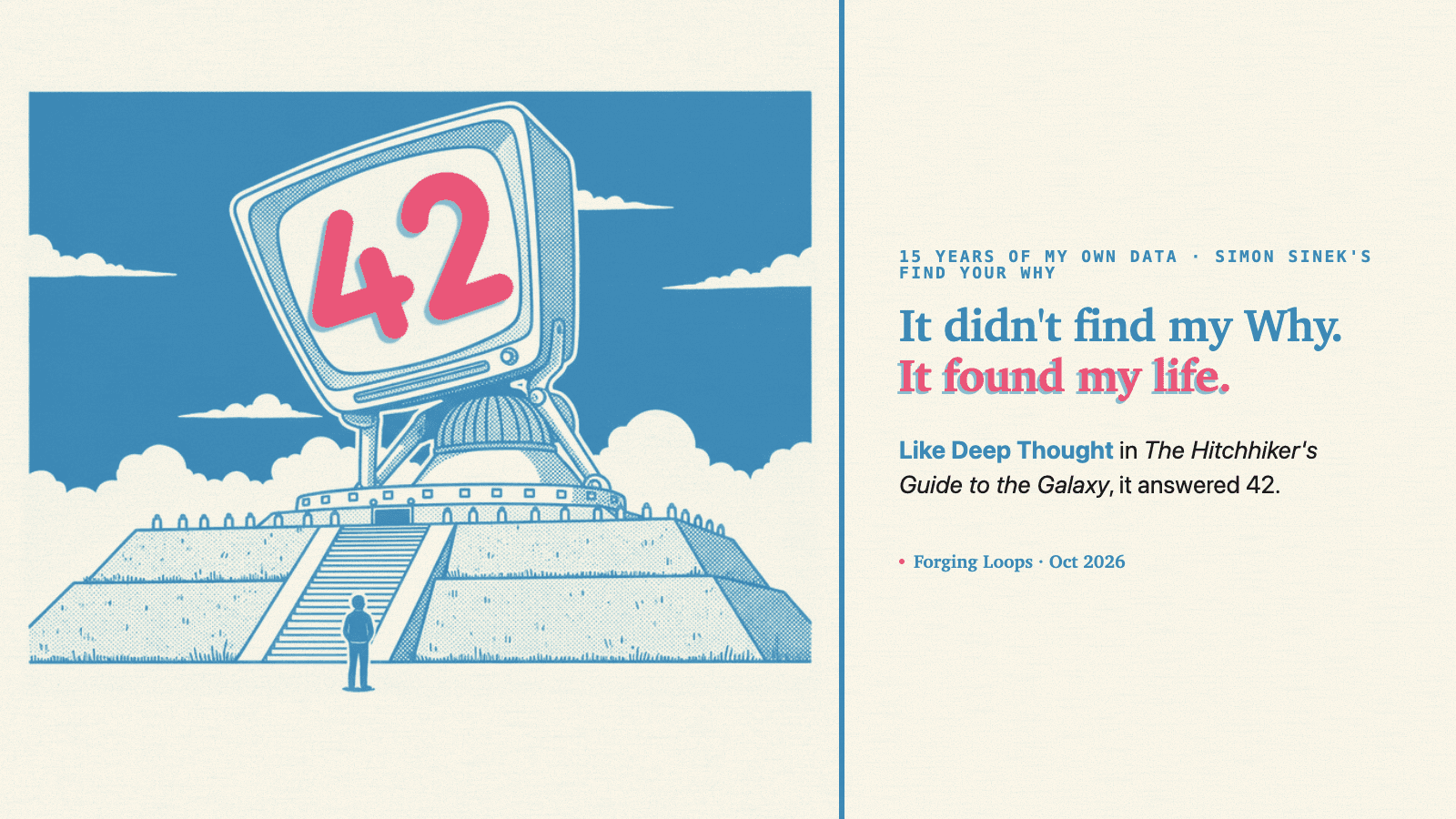
I gave AI 15 years of my life’s digital trail and asked it for the purpose of life. It answered 42.
How well does the internet know you? Well enough to know what drives you? What gets you out of bed in the morning?
I haven’t found my Why yet. The purpose that Simon Sinek describes in his talk.
Video: Simon Sinek, Start with why, TEDxPugetSound
Great talk.
I’ve tried to write mine down before. None of the drafts stuck.
Sinek says your Why is a filter. You hold every big decision against it.
His method sounds simple. You tell a partner specific stories from your life, the peaks and the valleys. Then you look for what repeats. The hard part is remembering the stories.
So I asked the internet.
I exported everything I could find: Google, mail, Facebook, Instagram, LinkedIn, X, Kindle, Amazon, my notes, every AI conversation I’ve had late at night. Twenty-two sources, 340,946 records, 2011 to 2026. Mostly traces: searches, videos, orders, map views. One big unsorted pile.
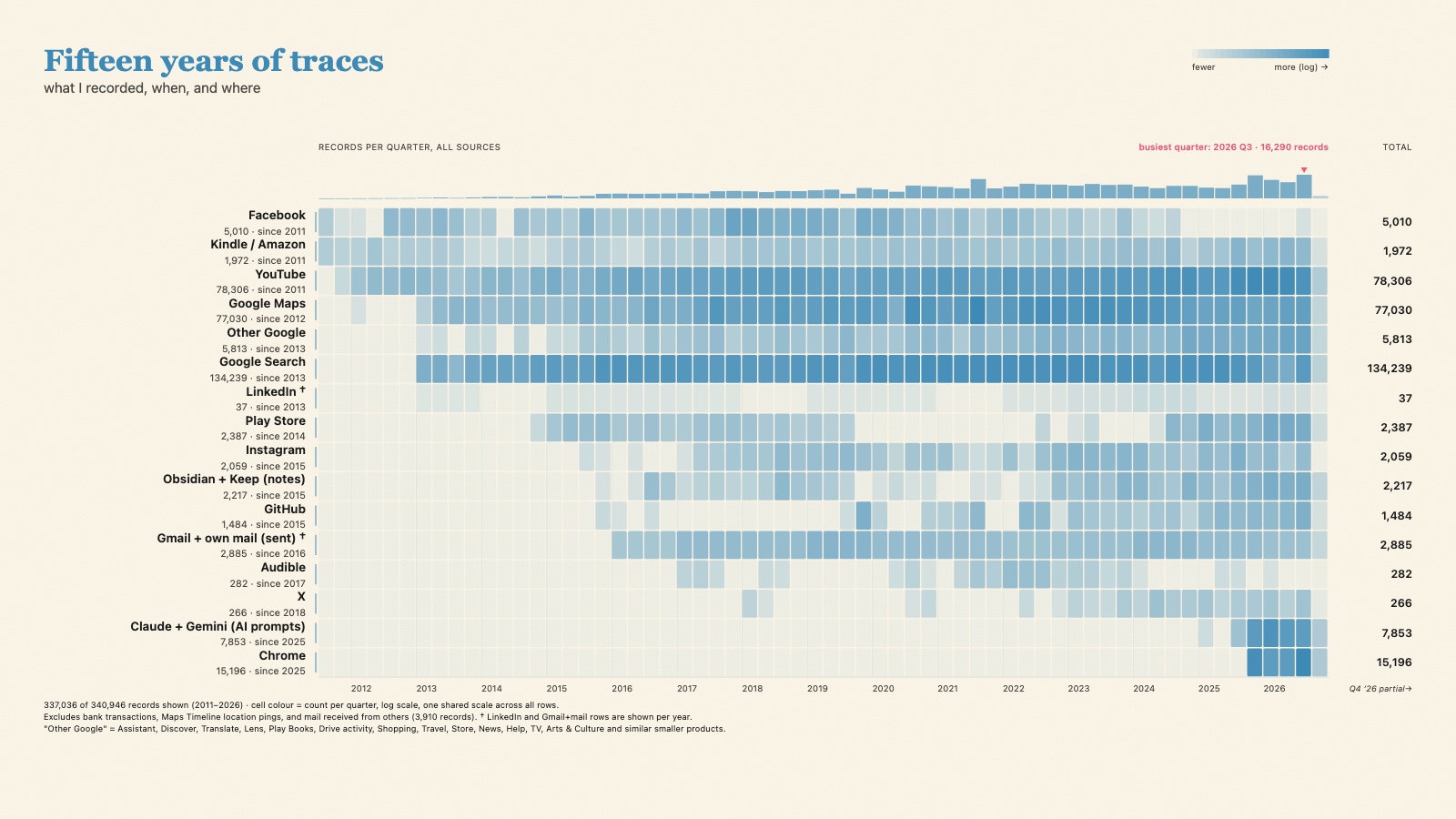
I didn’t have to sort any of it. AI did. Agents went through the pile in slices, pulled out the moments and put a date on each. Other agents checked every moment against the source. I like that part. It took 173 agents in 8 analysis runs.
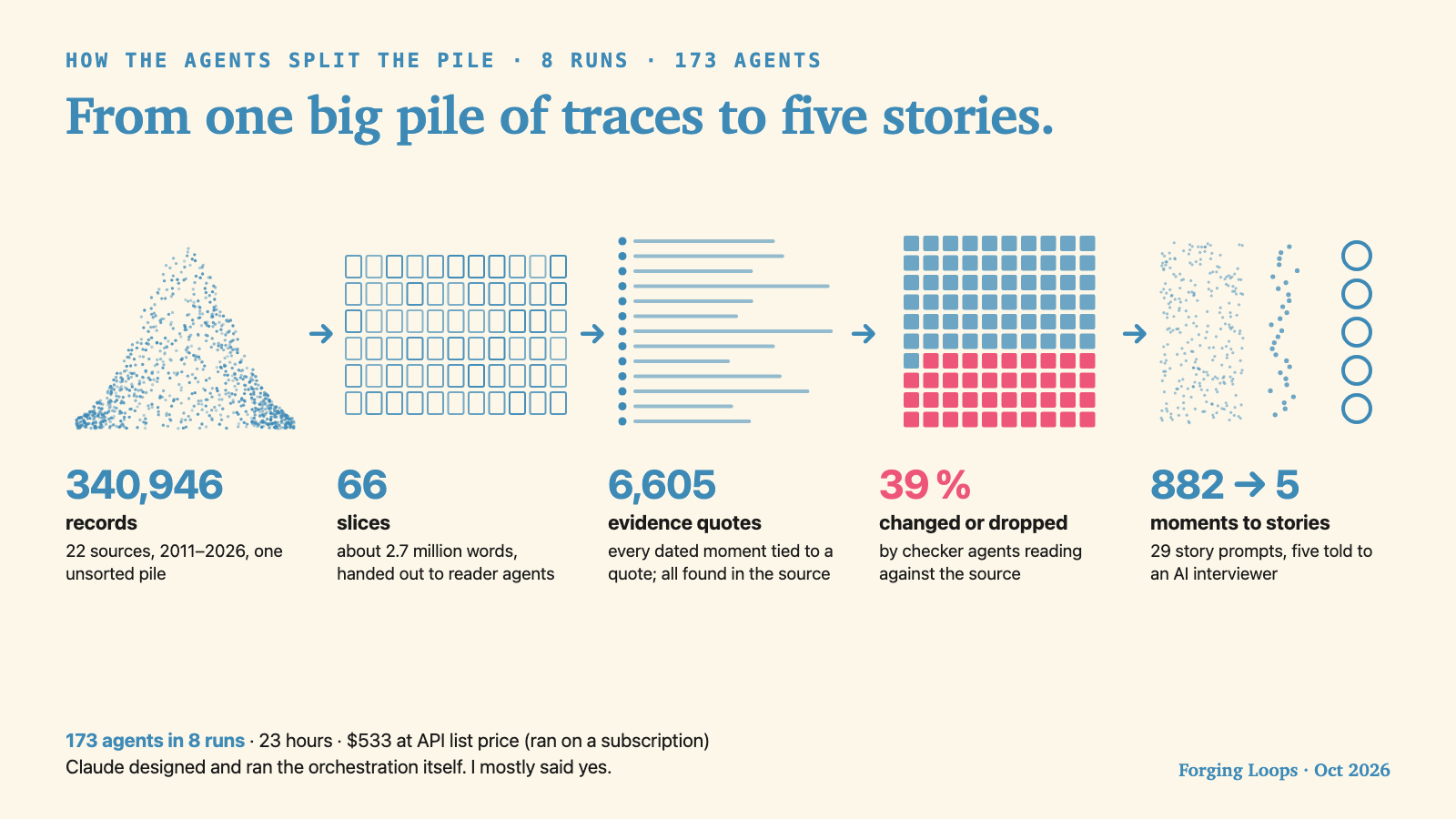
The moments became story prompts, peaks and valleys. An AI interviewer took me through five of them, one question at a time. I talked. It wrote down my words.
Doing it with an AI was actually quite cool. It’s a very easy thing to just talk to your computer. Drift off mid-question and it just waits. No judgment.
The interviews brought back so many memories.
It even knew how I met one of my closest friends from university. A Friday night in my first term in London, December 2017. I messaged six coursemates: did anyone want to study on campus the next day?
One came. We sat in the basement canteen over a problem sheet. She knew her stuff. I had no idea what was going on. It became a very important friendship. None of that was in my memory. It’s all from the trail.
The record also knew the less flattering parts.
That same first year, one spring morning, I googled “how many subjects can I fail, UCL physics”. That night I watched the training scene from Batman Begins on YouTube. To pick myself up, I suppose. In June I wrote that I had only just passed the maths exam. In the interview the number came back: “I got like 42 percent for the first maths course.” Remember that number.
A university had turned me down for a master’s. Then it sent me a reminder about its survey: feedback on the application process. Asking a rejected applicant for that? What a stupid idea. In February 2020 I wrote back.
I signed it “Not so kind regards, Your Rejection”. Under that: “(written to help Skynet learn)”. I had completely forgotten I ever sent it.
Six years later an AI found it.
December 2020. A new COVID variant was spreading, and Europe was closing its borders to the UK. I googled “rent a boat from London to Hamburg”. Two days later I tweeted “locked out of my home country”. I made it home for Christmas, by train through Paris.
And then you’re like, yeah, that was true.
By the end I had five stories and a true timeline of my life. The story notes came to 12,400 words, most of them my own.
I think now that’s what the data is good for: finding the stories.
And the Why?
In The Hitchhiker’s Guide to the Galaxy, a computer called Deep Thought thinks for seven and a half million years about the meaning of life. Its answer is 42. The problem was the question.
Mine took 173 agents, not seven and a half million years. In a way, it answered 42 too. My question wasn’t precise enough either.
There it is, the 42. Like my first maths course.
I did write a sentence at the end, the way Sinek says. I showed it to a few people. It’s really weak. It doesn’t mean much. I’m not really behind it.
What it did find was my life. A timeline I had never seen, and stories I had forgotten.
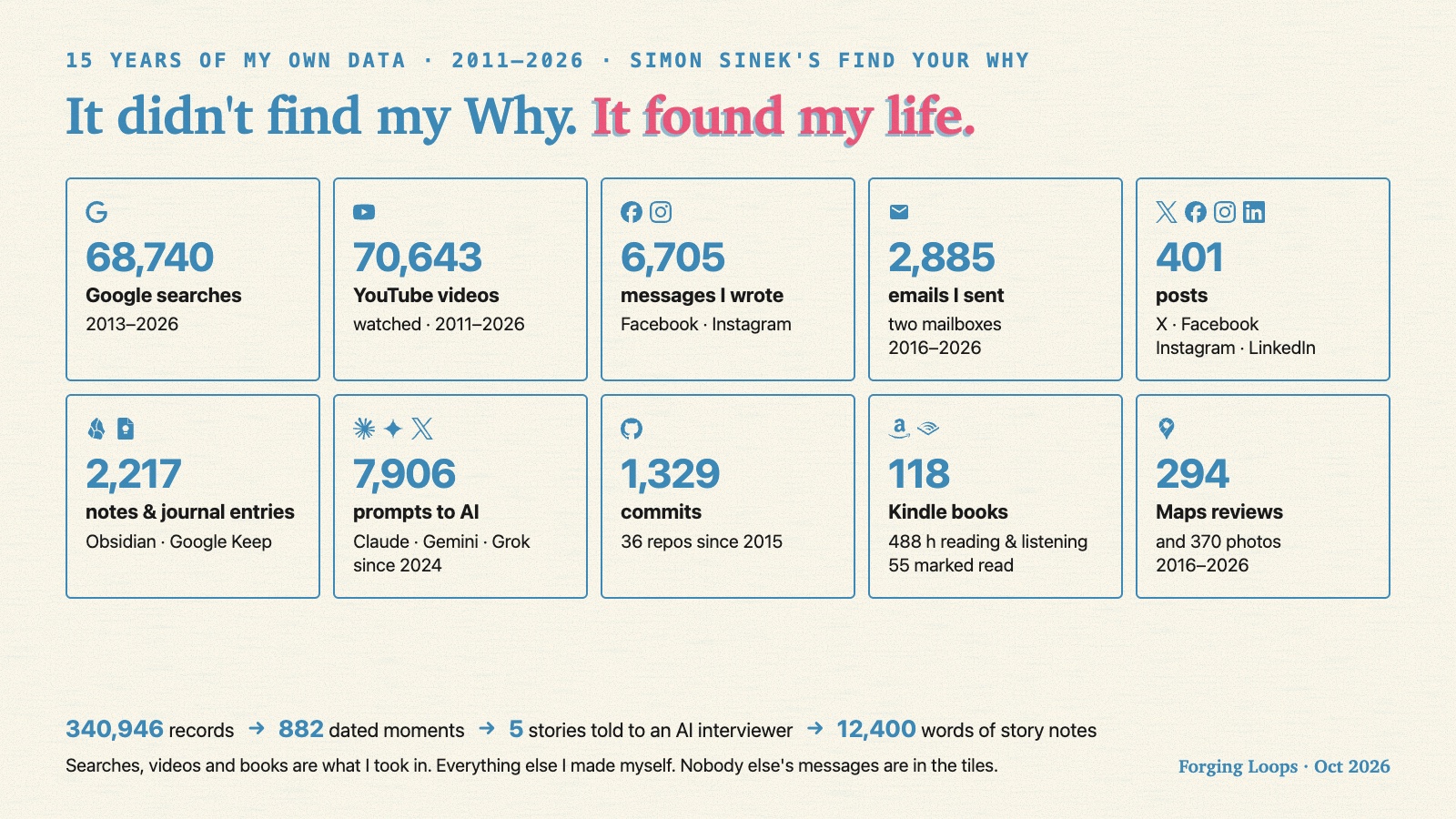
Searches, videos and books are what I took in. Everything else I made myself. Nobody else’s messages are in the tiles.
If you try Sinek’s method, I’d do two things.
Rebuild your timeline from your data first. Export everything and let AI put it in order. That alone is worth it. Google and the others already use my data. I’d rather use it myself: for a perfect memory of my past, and to see which interests last.
Then tell your stories before you read any AI summary of yourself.
Yes, I sent a big part of my digital life through Anthropic’s servers. My side of my Facebook and Instagram chats too. I already live post-privacy.
So I still don’t know my Why. But I know my life a lot better. Now I just need a better question.
◆
How it was made: 173 Claude agents in 8 analysis runs. The charts made with Claude from my own exports, the Deep Thought image with Gemini, Oct 2026. Service logos belong to their owners.